Showing posts with label Action Scenes. Show all posts

Thursday, January 25, 2018

Infinity Cheat Sheets

I made some cheat sheets for the Infinity RPG. Others (such as the excellent Jens Christian Ploug) have made more exhaustive sheets, which are worth checking out. These are simple handouts, somewhat lacking in info when compared to the awesome GM screen that's coming out and these other entries.

But I think they're pretty easy to read, and feel super legit to me. I faked our awesome layout guru's style well enough, I think. So yeah: they look slick, and should be a good handout for demo games, con games, new players, or people like me who can't keep all this stuff in their brain.

No more Teasing: Here are your HYPER LINKS  (they are actually pretty calm):


THIS IS THE VERSION FOR YOUR SCREEN

THIS IS THE VERSION FOR PRINTING though it works on your screen too

wooo, how 'bout that?

~Killstring

Saturday, January 20, 2018

You're in the Danger Zone (2d20 Combat)

Zones! They're great. But for folks who are used to pulling out a measuring tape, it can be a bit of a transition. Combat in 2d20 is much more narratively dynamic than a lot of turn-based tactics games: there's a lot going on, and abstraction is part of what makes that go.

But first, let's talk about zone maps.

Talkin' 'Bout Zones

So, let's take a look at a cool piece of isometric art.
Awesome isomeric art courtesy of jgrainger.deviantart.com.
Pretty rad scene, right? Nice little cafe. What a great place to have a shootout! But to do that, we'll want to divy it up into zones. Looking at the art, I see six distinct areas of interest:

  1. Outside
  2. Center Tables
  3. Couch area
  4. Bar
  5. Left 1-Top
  6. Right 1-Top
Thinking in Inifnity terms, the chairs, tables, and glass probably provides Light Cover, whereas the bar provides Heavy Cover. 

So my zone map might look something like this: 

If this is too small, click here for a larger version.
What a wonderful place to get shot coffee.

Zones are Groups, not Just Distance

Obviously, distance plays a part in things. But zones are often full of stuff. In our above example, somebody on the north side and south side of the "Couch Zone" aren't next to each other, but moving around in that zone isn't a big deal.

So let's say that Miyamoto Musashi is trying to enjoy his latte in peace, but Joan of Arc is playing her French Canadian indie rock too loud. This being Infinity, shit's about to get real


So! Musashi wants to violently interact with Joan. He can shoot at her with his pistol (or throw a baguette at her, if he's not that angry): that's close range, so no penalties: though she is going to benefit from the light cover. Or, he could make his way over and punch Joan: that's actually easy too! Move past couches, vault over them, whatever: all that stuff is in close range: moving to any point within that zone is a free action. So vault that couch, and get within Reach: it's still a free action to get there. Then the punching can commence.

One thing to take away from this, is that they're not just standing there: they're moving around. Combat is dynamic: so just because someody's in a zone, that doesn't mean that they're standing there, making it easy to hit them, right? 

It's dynamic. Fluid. There's a lot of motion going on.

At Home on With the Range

But distance is a thing too. 

So after all this ruckus, the nice Hasassin Lasiq who runs the cafe has just had enough of these recreations wrecking her shop. So she pulls out her Viral Sniper Rifle, and takes aim.


Somebody woke up on the wrong side of the bed.
She's in the Bar zone, and they're in the Couch Zone, with Center Table Zone inbetween. So while it might be counter-intuitive to think of it, this is actually long range: perfect for a sniper. With no range penalties, Joan and Miyamoto are in some trouble: reluctantly, they agree to stop fighting, and settle their dispute with a game of dominoes. 

"But Killstring: that's awfully close for 'Long Range'"

Yep! That's the adjustment I was talking about. RPGs tend to happen in closer quarters than miniatures games: it's a different genre of expression, if you like. Just like how in a kung fu film, everybody knows how to block, but in a beat'em up video game, hardly anyone does. 

But more importantly, the long-range weapon is good at taking aim and firing in a precise manner: you wouldn't want to shoot it from the hip. So yeah, in the manga-inspired, kinetic action of Infinity, this is a perfectly reasonable range to fire a sniper rifle in.

"Ok, fine. But what about long Long Range? Does that still work?"

Yep! It's just about finding a shot.

So let's say that you're at a football field. (Non-American football, 'cause that's what I got art for)

https://phuymatric.deviantart.com/art/Basic-Isometric-Football-field-521360372. Pretty Cool!

That's a big open space! I'd say that each colored bleacher would be its own zone, each half of the pitch would be one, and the different sidelines would each be one too. With big zones like these, rounds might be a little longer, right? None of this D&D 3 seconds tomfoolery: this is cinematic. The rounds are as long as makes sense for what's going down.

On the topic of what's going down, Joan never paid her tab at the cafe. The poor Lasiq just wanted to retire in peace and make coffee: but she cannot abide by this insult. Thus, she hunts Joan to a football match. 

Joan likes to watch from the corner don't ask me why it is a mystery

So! Taking care not to shoot any of the players, the Lasiq takes aim. It's 3 zones away: that's Extreme range. It's a +1 to her difficulty, but that's nothing she can't handle. She takes aim, and the paintball hits, thoroughly embarrassing St. Joan during her day at the stadium. Mission accomplished.

If there weren't players on the pitch, the field might be one zone, so this might only be Long Range. It really depends on the scene. Bottom line: zones are full of stuff. That stuff, more than meters as the crow flies, determines how hard it is to get a bead on a target for ranged attacks, how easy it is to move, etc. People in 2d20 combat aren't sitting still: they're scrambling, moving, ducking for cover, and so on.

"So Wait, I have to make a map any time I wanna do stuff?"

Not at all! But it's probably a good idea to make a couple so that you get a feel for it. Zones are more art than science: I spend a lot of time saying "I think that's probably a zone, " and going from there. While you're likely to want visual representation every now and again, hopefully everybody gets enough of a feel for this that winging it becomes second nature.

"What was that? I think I zoned out."

It's cool, I'm zoned-out too. 

Anyway, hope that's useful! Perhaps next time, we'll talk about Quantronic Zones, for hacking adventures.

Until then, be excellent to each other!
~Killstring


Thursday, January 11, 2018

Conflict in 2d20

(Or as I like to call it, The Infinity Engine1)

Now that Infinity is finally in the hands of Kickstarter backers, folks are gearing up to run and play their first games. It's an exciting time!

This boy is very excited, and not at all asleep.
But with that excitement comes questions. Infinity has a couple subsystems - Acquisition, Combat, Hacking, Psywar - and this can seem kind of daunting at first glance. Systems like Shadowrun have trained a lot of gamers to brace for radically different mechanics in these subsystems, and while there can be merit to that approach, it understandably rankles people, and/or turns them off to the game.

"It's all one system. Learn one, and you know them all."

Understandably, some people have been asking about the different systems in Infinity, trying to make heads or tails of them. To that end, I've prepared this simple guide, but the most important thing to remember is that it's all one system. Learn one, and you know them all.

What do I mean by that? Read on.

The Core Mechanic

If you wanna do something in a 2d20 game, you roll... 2d20! Or 3, 4, 5, d20s, if you feel like adding extra dice to improve your odds, usually done by increasing Heat. You add the attribute and skill appropriate to the test together, and anything that rolls at or below that number is a success. Hooray for success! If you get more successes then necessary, you generate Momentum, which can be used to do all kinds of neat stuff. 

So that's the core. Pretty simple once you've done it a time or two: there are options at every stage, but it's as simple as:
  1. Pick up your dice
  2. Roll those dice
  3. Compare results to a target number
... which should be pretty familiar to people who roll dice.

The Conflict Engine

The core mechanic can get you through just about anything. Depending on your playstyle, you might never use anything else. As an aside, I've absolutely run games with very story-focused players where treating Ballistics like any other skill check was the way to go2. But we have these cool systems, and it'd be a shame to not use them. Thankfully, they're pretty easy to get the hang of as well.

Let's say that you have an obstacle, and you want to remove it. Great, let's inflict some damage; that'll do it. The setup here is basically the same.

  1. Pick up your dice
  2. Roll those Dice
  3. Compare results to a target number
...with some added steps. In Infinity, damage is usually 1+ the total of your [CD} (those are the fancy d6s). So we need to roll those too.
  1. Roll some fancy d6s (non-fancy is actually just fine)
  2. Add up all the ones and twos, and note the sixes (those are Effects)
And that's it for your roll. Then we do stuff with it! 

Stuff

In general, conflict follows a simple process:
  1. Take your Damage
  2. Subtract [Soak]
  3. Apply Damage to [Stress]
  4. Possibly add [Harms]
Stress is your incidental damage track. Like HP in D&D or video games, losing it doesn't do anything, but it gets you closer to bad stuff. Harms are your bad stuff: you get them when you run out of stress, take more than 5 damage in a single hit, or both.

And that's it! Now you know everything.

But Killstring, weren't you going to explain combat, hacking, etc?

Yep! And I just did.

Because those are all the same.

Let's say you wanna punch an evil alien. It's pretty evil, so it deserves a sound thrashing. Just follow the above steps. Armour (and maybe Cover) is going to be your Soak, Vigour is your Stress, and Wounds are your Harms. 

But let's say you wanna instead, hack into a soda machine, to get some free soda. Rad. Follow the above steps. Security (and maybe interference) is going to be you soak, Firewall is your Stress, and Breaches are your Harms.

Rinse, repeat. Once you recognize the system, you can quickly handle all the subsystems. Even Buying gear is the same. To paraphrase Nathan Dowdell (who wrote the thing), you can think of a purchase as an attack against your own resources. The item's Cost is your damage, your Earnings is soak, your Cashflow is stress, and any Shortfalls are Harms. And if you wanna go nuts, Assets are kinda like Reloads. :D

How many d20s will this get me? "All of them, Mr. Okada." Then let us make it rain.

And that's basically it.

But what about Psyops, Quantronic Zones, all that stuff?

It's important, sure! But it's still the same thing. 

Physical combat takes place in physical zones. I'f I'mma punch the aforementioned evil alien, I need to walk over to them to do it. Same thing with Quantronic or Social zones. 

Think of it like a dungeon crawl. If the goal is for the adventurers to open the treasure chest, they don't just roll Knowledge: Dungeoneering and get the chest, right? They go through rooms. Some of those rooms have traps. Some of them have baddies to fight. Some have secret passages. 

A big hacking job is the same way. Literally. Draw up a cute little zone map. Decide what connects. Put some stuff in it. The hacker travels from their entry point, to the treasure chest, overcoming obstacles on the way.

Psyops are pretty much the same as well. It gets a little more abstract, but it's basically a social network dungeon crawl.

But Killstring! What if I don't want to do a dungeon crawl for every hack or persuasion?

Then you shouldn't. Honestly, if you do want to, you still maybe shouldn't. Would you model every fight as a dungeon crawl? If I want to just punch this guy, can't I do it? He's right there. Same logic applies elsewhere. There's no need to do a big Psyop to gain access to the CEO of SuperEvilMegacorp, if they're standing in the same line at the coffeeshop, right? I can just start talking. 

The extra systems are ways to do full-on infiltration runs in every aspect of the tripartite battlefield of Infinity. And another way that the combat system = hacking = social. 

Once you get a good feel for one, just keep in mind that the others are pretty much the same. If it ever gets confusing, go with what you know, and work backwards. I know plenty of folks have extensive dungeon crawling experience: put that to work in your hacking runs! I bet you'll be pleased with the results.

Anyway!

I hope that this was useful and/or entertaining to folks. Please feel free to comment or hit me up on G+ or Twitter if I can help clarify anything.

May your games be epic, and not too exhausting to run. 

Be excellent to one another
~Kilstring

* * *

1 - I am so sorry (I am not sorry).

2 - "I wanna shoot the mook in their stupid head." Okay, roll Ballistics, difficulty 1. "Two Hits!" You have shot them in their stupid head. It is now much stupider, due to ventilation. Bye-bye, mook. "Hooray!" Sometimes, that's all that you need.

Tuesday, June 6, 2017

Adventure Mapping Part II – Welcome to the BRAIN STORM

Last time here on the Blog of Doom, we talked about Adventure Mapping – creating zones for different elements of your adventure. Today, let’s go into a bit more depth on the topic, by building a little adventure from the ground up, and walking through the process step-by-step.

Brainstorming

get it it is a brain storm and this is a visual pun and I AM SO SORRY, MY FRIENDS


So first, we need an idea. My brain is full of bizarre and strange things, but for an example, I kind of want to stick to something mot gamers are familiar with – so we’ll go with a D&D-style fantasy setting. You know the type – roaming heroes1 going from location-to-location, solving problems, kicking ass, getting paid, and so on.

Hell, we might even have them meet in a tavern – but if we do, our tavern should be rad as hell.

Our PCs will be solving a mystery – likely with violence, because D&D-style fantasy. So, we want a couple fights, but also some exploration, and a few character-focused scenes conductive to roleplaying. Ultimately, we want it to culminate in the PCs finding the villain and confronting them. Probably – but not necessarily – with violence. Because D&D-style fantasy.

Anyway, let’s brainstorm some elements2:
·         A town where it takes place – let’s call it Harrowvale, that sounds appropriately Forgotten Realms-ish3
o   From the name, Harrowvale is probably haunted by spooky boogums
o   Townspeople are wary and paranoid – and they’re right to be
·         A mystery to solve – gaunt, spooked townsfolk, disappearances, stuff like that
o   Someone in the town is secretly doing Bad Things In SecretTM
§  They’re a vampire, or fused with a devilish parasite – something that requires them to do Bad Things In SecretTM in order to survive
§  Thus far they’ve hung the blame on external forces – this is Harrowvale; people are harrowed – but the PCs are the first real investigators to show up
·         And that’s a problem
·         A tavern, because tavern reasons
o   I used to work at a rad place called The Winking Lizard Tavern4 in Cleveland – so how about The Winking Basilisk?
§  The thought of a Basilisk winking is both reassuring and terrifying to me – “I could kill you with a glance, but instead, I’mma be saucy.” I like it – this place has panache
§  Their drinks? Awesome. Their Food? Delicious. The staff? Bright-eyed, and happy. I want this place to not only contradict the crappy D&D Tavern archetype (it’s dark, and dirty, they serve a lukewarm gruel, and a watered-down ale), but also to stand in contrast to the rest of the town
·         Maybe the villain doesn’t prey on the tavern? Friendship, or a more practical motivation, like they need travelers to have some place to stay?
·         Some fights!
o   Spooky wraith-fight somewhere creepy, like a graveyard, catacombs, etc.
o   Zombies, cultists, or something else suitably distressing? Might want to save that for the last battle
o   Nearby goblinoid critters, who are not the problem per se, but are definitely going to take advantage of it
§  Make sure that the first two fights have clues as rewards – otherwise they’re kind of pointless
·         Some exploration!
o   Well, we’ve got some inferred locations from the above, like:
§  Spooky Catacombs!
§  Spooky Mountain!
§  The city itself, and its inhabitants – here’s where we’ll get most of our mystery investigation done
·         Some character-focused scenes
o   We can do some of this at the Tavern, since it’s going to be our hub, I think.
§  Big Henry the bartender, former adventurer, knows stuff and is a pleasant guy.
·         He takes no guff, but he’s not really got anything to prove. He’s familiar with the PC’s vocation – having done it himself – so he’s got useful tips
o   If the PC’s want his story, he made his fame as Henrietta Crimson5, until he had enough money to pay the Wizard’s College to permanently polymorph him into his current body. Having achieved his goal, he opened the Basilisk with the remainder of his treasure
o   A shady-looking dude in a corner, handing out jobs to attack the goblinoids
§  Depending on our tone, he can lampshade to greater or lesser degrees. We could go a couple ways with this guy
§  Also, he’ll make a good suspect for the villain – we need a couple
o   A cleric, priestess, some kind of religious figure of Good And Stuff
§  Earnest and exhausted
§  Here’s a chance to really explore the condition in the city – this poor healer’s been trying to stem the tide pretty much by herself, and it’s clearly taking a toll
§  She’s not an expert on magical maladies or strange beasts – she’s a healer
§  Having Said That, she’s probably the source for our “haunted wraith” fight, because CLERIC REASONS (I like clerics)
o   And of course, our villain themselves
§  Who I should probably flesh out beyond “reluctant monster” at some point
§  What if it’s our cleric’s sibling? Cliché, perhaps, but that’s only a problem if it’s cloying or clumsy. More to the point, it makes the cleric’s story more vital and interesting, and adds a human element

Killstring, That Was So Many Bullet Points

Sorry disembodied voice, that’s how my brainstorming works

But Could You Maybe Use Less?

We’ll give it a shot in the next section; please be patient, disembodied voice.

Okay, Cool. Can We Get Back On Topic?

Let’s.

Looking at the above list, let’s try and suss out our elements.

  1. Harrowvale itself. We probably don’t need it on the map, as everything takes place here, but it might be useful to describe certain areas, like Slums, or The Chapel
  2. The Mystery. This is going to come out in other elements, but we should be keeping it in mind.
  3. The Winking Basilisk. This is gonna be our hub, and provide a source of unobtrusive roleplaying opportunities – if players want to do more RP, this is a good launching point. If they’re more interested in procedural elements, they can use it as a base of operations, and a springboard
  4. Three fight scenes, one of which is our climax
    1. Haunted Location w/wraiths & such
    2. Goblinoid stronghold
    3. Final confrontation w/zombies or cultists, and our villain
  5. Exploration and investigation. It’s really more of a theme, but we should have three locations to explore, leading up to the above action sequences, as well as the city itself and its inhabitants
  6. Character-focused scenes. This should be more of a factor of our characters – if PCs want to interact with them, we’ll get these. And if PCs want to interact with each other, we’ll give them the option. With that in mind, here’s our dramatis personae
    1. Big Henry – knowledgeable, practical, and a foil for PCs grappling w/identity
    2. Dreilk the Grim, “shady corner guy” – morally ambiguous, choice/consequence point
    3. Sister Analise – compassionate, but this close to a crisis of faith
    4. Corianna, Analise’s sister, and our reluctant villain


That’s a concise list. We’ll certainly flesh it out further, but I like our pieces.  

Bringing It Together

Now that we’ve got our elements, we can start mapping out the adventure. We have our elements in-place, and we loosely know how they tie together. Past that, it’s a simple matter of playing connect-the-dots:


Ok! Now we've got a concise little map to follow. Sure, there might be other connections, and there's plenty of other things to explore in Harrowvale, but I think this hits our key points nicely.

And that's how you do it!

I kind of like this little adventure - I might flesh it out further, make a cute little module. If you're interested in such things - or have a suggestion, comment, or system you'd like to see it in - watch this space!

And thanks for coming to Harrowvale with me.


* * *

1 – Possibly in the Mythic Greek sense, as opposed to the modern usage.

2 – If you ever wanted to see ideas off the top of my head, here’s what it looks like.

3 – Personally, I don’t like the Forgotten Realms as a setting – it’s about as milquetoast fantasy as you can get. But! So many great writers have nailed the execution – Ed Greenwood, Chris Avellone, and R.A. Salvatore come to mind, though they’re hardly the only ones – that it doesn’t matter if the setting doesn’t interest me; I keep enjoying stuff set in it. So on one hand, I don’t like it. On the other hand, I often adore stuff set in it, and I get why it’s popular.

Also, I occasionally face-check against the setting; I originally went with “harrowdale,” but some quick googling showed that no, I wasn’t clever, that was just an existing city in Forgotten Realms. Because of course it was. Harrow-vale, on the other hand, also exists in a now-defunct MMO called Shadowbane, and AGGH I GIVE UP EVERYTHING HAS ALREADY BEEN EVERY NAME, AND THE SIMPSONS DID IT FIRST. Don’t care. It’s Harrowvale. /rant

4 – They had a big-old Iguana in a habitat; sometimes I got to go in and spray him down, scratch the back of his skull – me and that Iguana? We were bros.

5 – It always struck me as odd that in fantasy settings with transformative magic, that you wouldn’t see more transgender folk. Gender dysphoria is hardly a modern phenomenon – Ovid’s Metamorphasis is more than 2,000 years old – but we do have better tools to address it now. A magical society has those tools on-tap, so it’s reasonable to assume that some people would use them.


Monday, June 5, 2017

Adventure Mapping

Adventures, modules, scenarios, outlines – whatever you want to call them, curated story structures are as old as RPGs themselves. Recently, I’ve had the privilege to keep busy writing adventures1 for a couple different companies, while simultaneously watching some friends of mine working through published adventures as players and GMs.

This got me thinking.

Thinking about the ways that we create adventures, and the ways that we use them. Thinking about how I, as a writer and designer, can give my audience the best tools possible for what their games. Because let’s be clear on one thing: writing RPG adventures is different than writing video game quests, dialog for stage/screen, or writing fiction - as an adventure writer, I’m not telling a story. I’m giving someone else tools, in the hopes that they’ll be able to collaboratively tell a story with the rest of their group.

But it’s their story, and it’s always going to be their story.

Structures vs. Tools

So with that in mind, why are so many adventures structured like a novel? This isn’t a specific criticism; just an observation, and a question. Published adventures do it, and plenty of GM’s private notes do as well.

Just to be clear, I’m not innocent in this regard – my brainstorming sessions tend to look more like storyboards for teaser trailers, as I think about all the cool, dramatic scenes that are going to happen. Invariably, they go very differently than my plans; thus is the nature of improvisational storytelling. This isn’t a problem – my GMing style is highly dynamic, mostly reactive –I also make detailed plans, but usually throw them out the second my cast and crew take the stage.

I also have what, two decades2 as a performer under my belt at this time? That changes the way I approach things. We all have different experiences, and we use them differently – mine happen to make me prefer improvisation, yours might be different. But regardless of our approaches, when we use a published adventure, we’re looking for something from it. In my experience, that’s usually at least one of these three elements:
  •  Ideas – something to spark the GM’s creativity
  •  Overall Structure – a narrative scaffold to hang a game’s events on
  •  Procedural Elements – ready-made mechanical elements like NPCs and combat encounters

People want different things. One GM might just want to use the combat stats and loot tables, whereas another is just looking for plot hooks to mine, and another wants as much of the “heavy lifting” of running a game done for them, so they can focus on guiding the PCs through a curated experience, and focus on bringing it to life, and making it compelling. There’s no wrong way to do it – GMs will take what they need, and this is right and just.

But as a writer, it causes me to think about the way I present my scenarios. Am I giving my audience – that’s GMs – what they need to do their jobs? How can I do it better?

And that got me thinking about tools.

Adventure Zone Maps

An abstracted method for describing locations, “Zones” show up in a couple different RPGs, but really entered the RPG zeitgeist through Fate, working its way into different systems over time, officially or otherwise. Love’m or hate’m, Zones have shown up as a way of talking about spaces. And like many of Fate’s components, they’re useful in a lot of ways.

One of the cool things we3 do in Infinity is Social Network Mapping. For anyone unfamiliar with the field of Social Network Analysis, it’s essentially the science of how people form, use, and adapt connections with others. It’s great stuff, and forms a basis for how that game’s Psywar (social combat, if you prefer) rules function; think six degrees of separation, and you’re practically there. Anyway, when mapping out a Psywar encounter, you wouldn’t really do a traditional D&D-style grid map, but a list doesn’t work as well either – so we use social network maps. I won’t go into it too much here, other than to say I think it’s super rad, and a great way of thinking about social encounters.

But while putting some of these together, it struck me that there’s a lot of potential as a technique for planning – as well as running – adventures.

The basic idea is simple:
  1.  Create a list of important people, places, events, etc., and put’m in boxes
  2.  Figure out how they connect to each other
  3.  Connect those boxes, adding more bits when necessary
  4.  Congratulations, there is no step 4 – you already have a zone map

Rough Example

So, real quick, let’s walk through this. We’ve got a pretty basic adventure with three set-pieces, a primary villain, and some sandboxy exploration bits in-between. That gives us the following elements:

  • A Hub location, such as a city
  • Two important NPCs, each with information leading to a set-piece fight
  • Two set-piece fights, either of which can lead to the villain
  • Said villain
  • Our third and final set-piece - the final confrontation with our villain
So our zone map might look something like this:


Looks more or less like a flowchart, right? That’s the idea – one piece leads to another. Each of these can be a scene in its own right, or a piece of a larger puzzle - and that’s where the Zone Map comes into its own.

By treating each element as a zone, you can easily work through the adventure in different ways, zooming in and playing the scene as normal, or “moving through the zones” in a more abstracted fashion. Maybe you want to handle NPC 1 with a simple social roll to get to Fight 1, which you handle in detail. Maybe you then have a long, tense, dramatic scene with NPC2, which is awesome, but takes a while – so you decide to handle Fight 2 as a series of abstracted rolls.  

Making some notes, your updated map might look something like this:


Basically, each zone can either be a scene that you play in full resolution, or a challenge that can be bypassed with abstract description and a mechanical check, allowing you to tailor the experience to your style as a GM, the player’s preferences, and outside concerns (like schedules).

Get in the Zone

So that’s the basic idea – by drawing out your adventure as a zone map, you not only make sure that the PCs can get from point A to point B (and can figure out how adapt when (not if) PCs throw your plans or a loop, but you can zoom in and out to scenes as suits what you’re doing – and you can change it up on the fly

Anyway, that’s the idea – feel free to use it when mapping out your own adventures, or converting existing adventures. Next time, we’ll go through an example adventure, from ideas to map!

Be excellent to each other.
~Killstring

 * * *


1 – I’m just going to use the word “Adventure” to describe these, but feel free to substitute your terminology of choice in this space. J
2 – It has been brought to my attention that at some point, I got what a young Killstring would consider “old.” This is never not fascinating to me, as I’d never considered it a possibility. But here we are!
3 – To be clear, I wasn’t involved in designing these. I’ll crow endlessly about my accomplishments—real or imagined—elsewhere. I do like them, though!


Friday, August 5, 2016

RPG TIME!

It's time.

It's been a quiet month on the blogfront. Coming off a string of deadlines and conventions, I've been thinking a great deal about time. 

Specifically, how there never seems to be enough of it.

Time is Relative

This guy knew what was up.
But really, that depends on what you're doing, doesn't it? I might not have enough time to vacuum the apartment, or finish reading Dan Abnett's Ravenor trilogy1,, but I seem to keep finding ways I always have time to meet a deadline2.

Its not that there isn't enough time - there very clearly is - it's that there isn't enough time to get to everything I'd like to. Like everyone else, I have to prioritize if I want to get anything done.

Now, this isn't going to be a post on time management strategies - goodness knows that a quick Google search will provide more than you'll ever need on that front - but rather, I wanted to talk a little bit about pacing and duration in fiction, but specifically how those elements come into play in RPGs.

Runtime


Not all mediums are created equal. A novel has more room for slow burn storytelling than an ongoing longform television series does, which in turn has a greater capacity than a film, which still trumps network TV. Now, that's not to say that more is always better - plenty of films have died an unpleasant death by trying to stretch a good thirty-minute story into a two-hour epic - but different types of stories benefit from being handled differently. 

It's not something we usually talk about in RPGs. 

In fairness, timeslot isn't always something we can control. You might have a killer group of dynamic, nuanced characters, a compelling and epic narrative, and truly deep strategic challenges all going for you, but if your gaming group meets for three hours on alternating Wednesday nights, that can be tough to pull off. Equally tricky is the superb "Popcorn GM3" who has a tight, action-packed romp all ready to go, and is now trying to fit that into an eight-hour long weekend game session.

Gameplay is also going to be affected by this. I love 2D fighting games - Street Fighter II Turbo remains my all-time jam - but matches are short for a reason. I wouldn't want to play a half-hour round of Street Fighter any more than I'd want to keep my chess matches to three minutes or less; and not just because in both cases, I'd be losing in embarrassing fashion.

I mean, that too. 

The practical elements of RPG mechanics can be deeply affected by time constraints. Games like Savage Worlds and Spirit of the Century (and later, Fate Core) have carved out impressive niches for themselves by mechanically supporting shorter sessions from the ground up. Easy to pick up, fast and elegant resolution, and character creation doesn't take long at all. If you've got a weeknight game with limited time, and an inconsistent cast - like the games' creators had when they were first making their rulesets - then you've got a toolset tailored to your needs. And if not, you might like those games anyway - they've certainly been used in long-running, long-term games over the years with great success - but then again, you might want something with a bit more detail, if you've got the time to make use of it.

Point being, there are a lot of practical things that your timeslot is going to affect, and it's worth keeping that in mind.


Duration


Let's say you've just read a good novel. Hooray! But now you're thinking: would it be even better as a trilogy? How about a seven-part series? Maybe an ongoing serial - like in mainstream comics or television - that just keeps going until interest wanes, or the writers go insane?

Or maybe, just maybe, it would have been best served as a short story?

On one hand, professionally produced entertainment has its own unique pressures - there's no producer breathing down the GM's neck, trying to wring a trilogy out of a completed storyline - so this should be easier to approach objectively. On the other hand, between creative fatigue, falling in love with a particular element, or audience demand, RPGs also grapple with the issue of how long a given story should run for. In some ways, it can be worse.

But not every type of story can hold up over long periods of time, or in short ones for that matter. Blitzing through the entirety of the Lord of the Rings trilogy in a 90 minute film would have been an unmitigated disaster, yes - but so would dragging Casablanca through three films at 11+ hours, with a prequel trilogy in the works.


"Hurry up and do it, Rick, before we get Casablanca: The Musical on Ice. Just, just let it end already."
Basically, you want to make sure you're giving your game the right amount of time for the story you're trying to create. Early D&D had a very strong serial episodic theme baked in - again, the game had a lot of qualities that we'd associate with "Roguelikes" today - and so most games were assumed to follow that model. Like comic books, or The Simpsons4, it was assumed that your game was a series of loosely-connected episodes featuring the same characters in the same world, and that you'd drive that car until it ran out of gas.

It's a good model! It's just not the only one.

If you're telling the kind of story that lends itself to that format - say, plucky teen investigators solve supernatural mysteries, and fight a different monster every week - then yeah, maybe ride that train all night.

Conversely, if you're trying to tell the story of how plucky teen investigators gradually discover the alien horror of their small town, in increasingly Lovecraftian fashion? Well, that story has a beginning, middle, and definitely an end. Too many games rob themselves of satisfying conclusions out of a (totally understandable) desire to keep a good thing going.

Sometimes, things come to an end, and that's ok.

Bottom line, the duration of your game has a sizable impact on the type of game you run, and vice versa. Getting those into alignment can go a long way towards a more satisfying experience from top to bottom.

Pace


In Hamlet's Hit Points - which is absolutely worth checking out - Robin Laws talks about the beats of a story; moments that lead the audience toward either hope or fear, taking them on an emotional roller coaster before the tale's through. And while this is entirely delightful on its own, it also serves to highlight another aspect of gaming that doesn't get talked about a lot: pacing.

Putting thought into the pace of your gaming sessions can work wonders. Not just from an emotional standpoint: while that's (really) important, there's also a variety of practical concerns to manage. In any given game, the PCs might be:
  • Questioning witnesses
  • Engaging in combat
  • Getting to know other characters
  • Searching a room for clues
...and so on. And while those are different scenes from an emotional standpoint - as audience and characters - they're also different from a practical standpoint as players. Simply put, we do a lot of different stuff in RPGs, and mixing types can be useful. Looking at our examples above, the players are doing different things, right? 
  • Questioning witnesses - players are talking, possibly checking notes, maybe the occasional roll
  • Engaging in combat - players are rolling dice, interacting with their character sheets, and possibly other peripherals like maps and miniatures, while also describing action
  • Getting to know other characters - players are primarily talking
  • Searching a room for clues - players are briefly describing action, listening to narration, and rolling dice
So that sequence alternates between roleplay-focused dramatic scenes and mechanics-focused procedural scenes. That's one way to do it, but certainly not the only way; just keep an eye on the flow of your sessions. If something's starting to feel a little stale, you might do well to shift to a different kind of scene, not just in terms of content, but in what the players are doing. A combat followed by a chase, followed by a combat can be exactly what you want - or it can be a bit too much of the same thing - but it pays to know which.

Like always, a dash of mindfulness regarding your group will go a long way.

Our Time is at an End


RPGs can be a time-consuming hobby, but that doesn't have to be a bad thing. Like anything else, we have to prioritize. And by keeping tabs on the runtime, duration, and pace of our sessions, we can master this terrible force, and put it to work for us, like ladies and lords... of time. I guess? If only there were a conveniently geeky pop-culture reference to make here.

It was my hope that this joke would be bigger on the inside.
Regardless, that's all the time we have. On a related note, if people would like to see a checklist for pace (as I've sometimes used myself,) let me know, and I'll whip one up.

Until next.... man, I can't do it. Until next installment.

Cheers!
~Killstring

***

1 - Which is a crying shame. Dan Abnett's a hell of an author, and after reading his excellent Eisenhorn trilogy, I finally understood why people like Warhammer 40K! Highly recommended.

2 - I've said it before, and I'll likely do so in the future - just being the person who reliably shows up to work is a marketable and important skill. Hone your craft, chase excellence, but for the love of all that is good, make your deadlines.

3 - Sometimes referred to as a "Beer & Pretzels GM," but I don't drink beer, nor am I super fond of pretzels. Trivia! Anyway, it's used to describe a more casual style, like a summer action flick - fun, usually violent, and don't think too hard about the plot as that's not really the point.

4 - Sometimes I think that The Simpsons will outlive not only its creators, but every human being who was alive at the time of its creation. In the post-apocalyptic hellscape of humanity's distant future, it'll be mutant cockroaches eating Twinkies and watching The Simpsons. 

In other news, life after the apocalypse sounds distressingly similar to my teenage years.

Friday, June 24, 2016

Creating a soundtrack for your RPG

Music is powerful. 

It's been a part of my life in many ways since I was young. I spent the better part of six years performing it, promoting it, eating1, breathing and sleeping it. During my first go-round in college - before taking those aforementioned six years - I was a theatre student, focused on sound design. I studied the impact that music can have on a dramatic scene, the way it could elevate a mood, increase tension, or accentuate tone. Especially in "black box" theatre, an awful lot is left up to the audience's imagination, and music is a great way to excite and enhance that.

I don't know if I was ever good as a sound designer. There was a lot of praise, and I worked on some award-nominated stuff, but it's not like I set the world on fire as a college student.

But!

I definitely tried to learn as much as I could. Live sound, studying pro audio at the Recording Workshop, and dozens of little projects here and there. I'd like to think that I picked some things up along the way.

Is it any wonder that as I became more and more involved with RPGs, that I'd try to apply what I'd learned?

Lovely album all the way 'round, and full of great "intro themes."

So, what are we doing here?

Soundtracking your RPG sessions can be a great way to enhance the experience for everyone. Not unlike live theatre or written fiction, there's a lot that your imagination needs to fill in to complete the scene. Visuals, emotions, physical posture - so much of what's going on in a scene can be intuited through a soundtrack.

It can also be a great big distraction if handled indelicately.

We're not going to delve too deeply into communication theory2, but there's some basic concepts that are important:

The Tone, or how the mood of music will inform the mood of the scene
The Association of a particular sound cue with some story element
The Practical Realities of adding additional sounds to a sound-based medium

These aren't scientific terms, just some things we should keep in mind.

Tone

This is what most people think of when we talk about soundtracks - the excellent use of musical score in Game of Thrones, or the Mass Effect games is a great example of this - emotional content underscored by appropriate music. Sad scenes can be punctuated by appropriately melancholic or sorrowful melodies, and a pulse-pounding action scene certainly benefits from a complimentary score.

Association

This requires some forethought, but linked elements can provide consistency. Instruments, composers, and specific songs can all form associations that you can use later. If a certain song plays when an antagonist is introduced, it can not only highlight elements of their character you want to emphasize, but can help accentuate those traits in later scenes.

Needless to say, you'll want to avoid anything that your table already has a strong association with. If everybody's played Mass Effect, don't use its most memorable songs in your soundtrack; that'll conjure up memories of the other property3 distracting from your game.

I tend to emphasize associations for situations rather than characters, as too much micro-managing while GMing leads to a disjointed experience. Speaking of!

Practical Realities

RPGs are a primarily auditory medium - information is conferred via the spoken word more than anything else. Music can be a powerful tool to fill in conceptual gaps, but it's also more noise; you want it to enhance your game, not distract your table. Some things to keep in mind:

First, volume levels. Ever step into a bar, and you can't hear your friends over the chatter and music? That's partially due to what we call a Sound Floor - basically, the ambient noise level you have to talk over in order to be heard. Your music should be loud enough to be audible, and to provide enjoyment in its own right, but not so loud that you need to talk over it. It's not a bad guideline to set it to a level that feels about right, then walk it back a little. You can always turn it up later.

Secondly, frequency. Not as in how often something happens, but rather the frequency it vibrates at. Human speech tends to hang out in the 150hz-500hz range, so you'll want to cut that by a couple decibels for gaming purposes. The idea is to carve out some sonic real estate for people's voices, give them room so they're not fighting with the score.

In other words, don't EQ your soundtrack to sound great by itself; it's a supporting actor, there to make the stars look good.
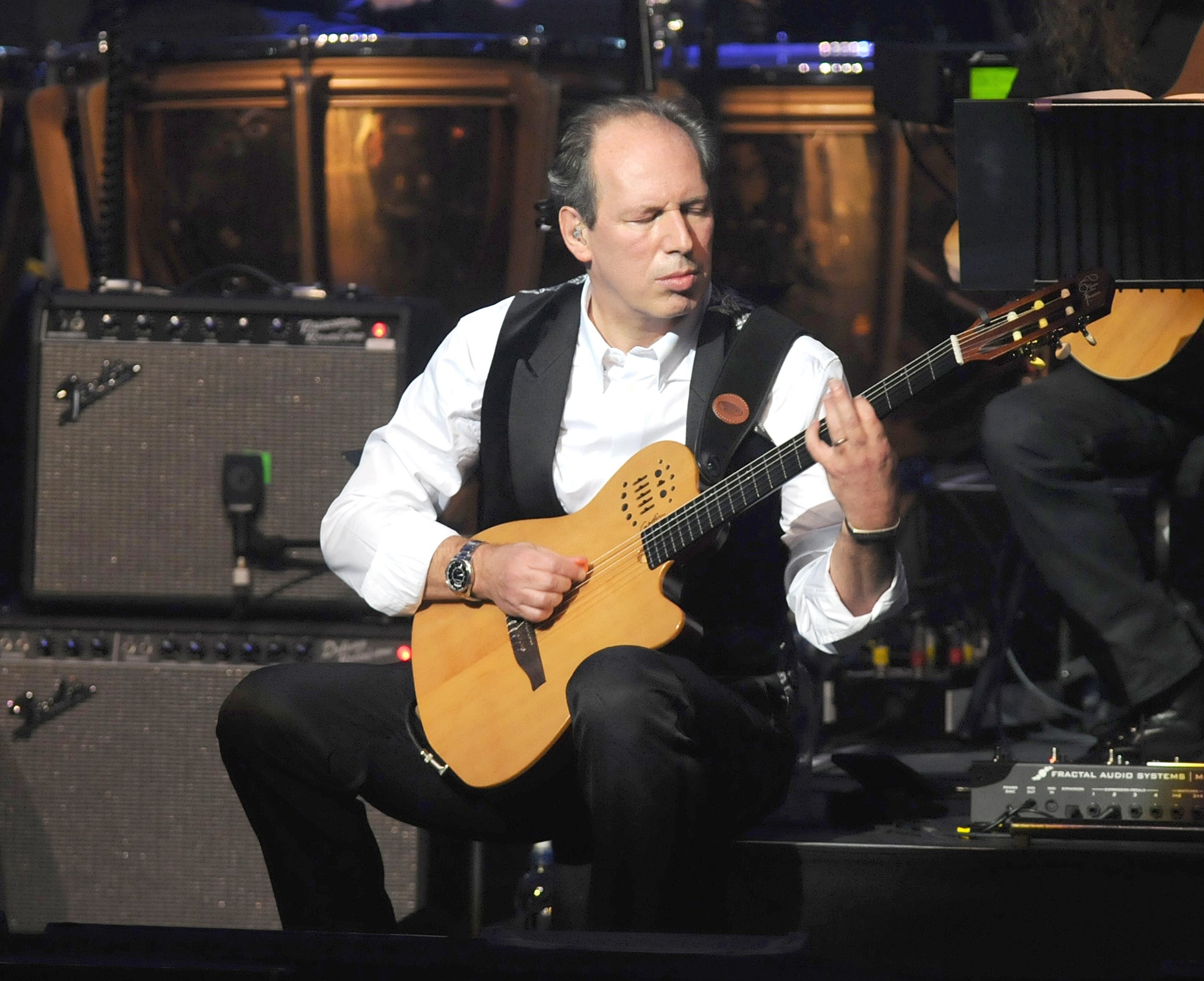
More like HANDSOME Zimmer, amirite?
(Please don't get a restraining order, I just like your work.)

Thirdly, you don't want anything that's too busy. Epic Trailer Music like Audiomachine or Two Steps From Hell can be lovely, but there's usually so much going on that it can get distracting, and detract from the game. Likewise - and I know this might sound strange and heretical - but that film soundtrack you love so much, the one that would be perfect for your RPG?

Don't use it. Ever.

Look, I love Hans Zimmer as much as the next guy, possibly even more. But his music is designed for films, which are timed down to the frame. Long quiet stretches are interspersed with sudden, dramatic crescendos. In the film, they tie in perfectly to the action. 

In an RPG, they come out of nowhere - they draw attention away from the story, and put it on the weirdly sudden burst of French horns and violas. Don't do it.

Finally, you want to avoid anything with lyrics in a language anyone speaks, and probably altogether (remember that bit about making space for the human voice? Competing human voices don't help.) It can work great in film, anime, even some video games - but ours is an auditory medium, and it's just too much information in the same channel.

Where do I get it from?


It bears repeating: not all music is going to work for these purposes. In fact, music that you like - because it's interesting - may not work so well. Because it's interesting. 

Stay away from anything designed for a symphonic orchestra - while this is some of the most beautiful music imaginable, it runs directly counter to our purposes. And while film scores tend to be pretty bad, video game soundtracks can be downright amazing for our purposes. They're designed to be more dynamic. Events don't happen at a set pace in games; your score needs to support myriad options in order to be successful. This, by the way, is exactly what we want. Beyond that, the New Age genre has some delightful contributions, as do many electronic "chillout" artists. 
Recommendations could - and soon will! - take up an entire post by themselves. But the key to remember is that you want something that's less dynamic than most music. Is there something you like, but find boring? Now's the time to bust it out.

Putting it All Together


So now that we've covered the basics, let's talk about actually putting together a soundtrack for your game. What follows is how I do it - it's not the One True Way, but it is A Way I Guess, which capitalises just as nicely.

When I'm getting ready to start a new campaign, I put together a couple playlists. I use Google Play, but anything that lets you assemble playlists is fine. I generally want a couple playlists ready to go:

  • A "Chill" playlist. This is my default, it sets the tone, but mostly provides ambiance
  • An "Action" playlist. Fight scenes, parkour chases, starship battles. Something more uptempo that delineates these scenes from normal play
  • A "Suspense" or "Investigation" playlist. Nothing too intense, but more downtempo, minor key stuff. 
  • An "Emotional" playlist, that's appropriate for sad, tragic, melancholic scenes.
And those are my big four. I'll usually have more - often lots more - but that should get me through most games I run. If you're less intent on dancing on your players' heartstrings4 then you could probably get away without the last one. Typically, I'll want the "Chill" playlist to be pretty long - something that covers the length of the game session, if I can help it. That way, if I want to just set it and forget it, I can do so without worrying that it'll cut out at an inopportune moment.

I personally like to stream music from a tablet to a bluetooth receiver - this way I've got my finger on the volume if I need it, and I can switch playlists with ease. When it comes time to switch, I'll often cue up the playlist I want to play next, so there's no jarring transitions.

Of course, sometimes I want jarring transitions. "Boss Fight Music" is a time-honored tradition, and one that I make extensive use of.

I also tend to make "pre-show" playlists. These are an artifact from my theatre days, where you want some music to play while people are making their way in. I've found that this is a good place for more involved compositions that I really like, but are probably too busy or dynamic to use during play.

I tend to think of this as "opening credits" music; it sets the tone while people are making their way in, getting snacks, catching up. I also like to open each game with the same piece of music, as I've found that to be wonderful for setting the tone of the game, as well as transitioning out of "social time" into "game time."

In Conclusion

Music is awesome. It's added so, so, so much to my games. I sincerely hope this can help you gain some of the same benefits that I have.

Rock on! Just, y'know, quietly and in the background :P

~Killstring


* * *

1 - Good thing too, as it didn't pay me enough to eat much else ;)

2 - Though if you are interested, this plays off concept like the Elaboration Likelihood Model's concept of Peripheral Routes, Framing Theory, Priming Theory, and every advertising technique in history. If you're interested in the topic, Cialdini's Influence: The Psychology of Persuasion, Revised Edition (affiliate link) is a super accessible resource. 

If I ever teach university again, I want to do a persuasion class called "Defense Against the Dark Arts." Influence will be required reading.

3 - When do you break this rule? When that's what you want! I ran a Mass Effect game to great success - my players hadn't played the series, but I had. It made a difference for me, and that influenced my descriptions. 

Incedentally, they're playing the video games now, and getting associations from our tabletop! 

4 - Hi players! How are your hopes and dreams this fine day? :D

Friday, June 10, 2016

Killstring's Fight Scene Checklist!


This is a continuation of an idea first put forth here. For access to a printable version of the checklist in Google Docs, go Here. To see a completed version, based on an actual game, go here!

Killstring's Fight Scene Checklist

Hi everybody! I'd planned on writing a post to day about life as a freelancer, and how to be successful in this field. One of the major themes is keeping your promises, and delivering by deadlines. 

As it turns out, I promised to hit a couple quick deadlines yesterday, so today's post should be pretty brief. Ah, stop cheering, I can hear you y'know1.

Anyway, here's the worksheet to go with the last post. This can be incredibly useful if you have an idea in your head, and not much time to prep. Additionally, if you're using a more narative game, many of your answers can be come game mechanics without much work.

Heck, if you're playing Fate, you can treat every answer you jot down as an aspect! Otherwise, brisk notes will do - if it seems like there's not a lot of room to scribble, that's by design - keep it nice and concise.

Anyway, I hope this proves useful - it sure has for me.

Again, from AMC's excellent Into the Badlands. Fight!


A Checklist for you!


High Concept

What is this scene’s Elevator Pitch?


What is this fight about?


Environment

Where is the fight taking place?


How can the players interact with the environment? The antagonists?


Participants

Who’s participating in this fight?


Is there anyone who isn’t, but happens to be there anyway?


Goals

What are the players trying to accomplish?


What are the antagonists trying to accomplish?


Stakes

What do the players stand to lose?


What do the antagonists stand to lose?


Challenge

How difficult is this fight supposed to be?


What’s going to make it that way?


Feel

What emotion(s) should the fight elicit?


What kind of pace should it have?


Style

What are some key sensory elements?


What tone should it have?


And that's it!

May all your action scenes be delightful
~Killstring

* * *
1 - This moment brought to you by the NSA.