Showing posts with label Orson Scott Card. Show all posts

Friday, May 6, 2016

Using MICE to get your RPG on the same page

In any collaborative effort, it's important to get everybody on the same page. This is especially true in RPGs, where radically different expectations can exist, and there isn't always an obvious way to communicate that. Nobody likes having their expectations violated.

It is in fact, a core component of not liking things.1 

A few years back, Christopher Chinn created an excellent little survey called The Same Page Tool that does a great job of asking some of these questions more explicitly. This is good! Communication is good.2  And while I definitely recommend tweaking Chinn's instrument to suit your specific needs, that's not an indictment; I recommend doing that with pretty much everything. The important part is that we're talking about what the game will be before it starts.

Segue!

they look so happy oh my gods i want one
It's hard not to use people on Segways as a segue. Note my failure in this regard.
So, my fascination with Orson Scott Card's MICE Quotient is pretty well-documented at this point, as is my desire to apply it to the field of Role-Playing Games. So it should come as no surprise that it's now intersected with my passion for group communication in the form of a survey for your gaming group.

I mean, come on. It's the title of the post. I really hope it's not a surprise.

Actually though, it's two surveys. Reasons!


And good reasons at that. These different paradigms are absolutely compatible - they can, and often will, exist side-by-side in the same game - but in this case, what we don't know can absolutely hurt us.3  There's two surveys here, one each for GMs and players. I haven't robustly tested this survey instrument, and there are a couple things possibly being conflated here.4 Since this is a discussion tool, and not an instrument of empirical measurement, I figure that's probably ok.

So, here are our surveys! There will be a key at the bottom, but the basic idea is simple: rank your agreement with each statement on a scale of 1-5, with 1 = Strongly Disagree, and 5 = Strongly Agree. Don't worry about "getting it right," or "what a given question is supposed to mean," just go with what seems appropriate.

Your score in a given category equals the sum of your answers, minus the score of the reverse-coded question (again, they'll be pointed out in the key afterward, but you can probably spot them.) This generates a score from 0-15 in each dimension, which is primarily of use when compared to the other dimensions.

Again, it's a discussion tool. Make sure to discuss.

If people are interested, I can do a more objective version of this, which doesn't flagrantly advertise what it's asking you about, but I figured this format was fine for a discussion tool.

Anyway, that's enough explanation. Let's talk about MICE!


These little guys are ready for some serious action. And so are we!

GMs

Milieu
  1. I have prepared a lot of detail about the world, and I’m excited for the players to see it
  2. You could call this a “discovery campaign,” where PCs find out about the setting
  3. The quirks, details, and minutiae of the setting are unimportant to this game
  4. A plot arc ends when there’s nothing left to see where the PCs are
Idea
  1. You could call this an “episodic campaign;” where the PCs solve a series of problems
  2. I expect the PCs to investigate mysteries, complete quests, and fix things
  3. A plot arc ends when the PCs have gotten to the bottom of things
  4. Challenges like puzzles and mysteries are not a big part of my plans
Character
  1. I have prepared, or expect to create, lots of interesting NPCs for this game
  2. You could call this a “dramatic campaign,” where characters grapple with their emotions
  3. I’m more interested in what happens than the people it’s happening to
  4. A plot arc ends when somebody’s resolved their emotional/relationship conflict

Event
  1. I’ve prepared a conflict that places the world in jeopardy, it’s up to the PCs to set that right
  2. There’s no one “big bad,” and the PCs are not out to save the world
  3. You could call this an “epic campaign,” where characters fix an imbalance in the setting
  4. A plot arc ends when a major wrong in the setting is made right

PCs

Milieu
  1. I’m excited to explore the setting
  2. You could call my character an explorer
  3. I care about what’s happening in the setting, not the setting itself
  4. A plot arc ends when there’s nothing left for the characters to discover here

Idea
  1. I’m excited to solve mysteries
  2. You could call my character an investigator
  3. I’d rather gloss over puzzles, investigations and the like
  4. A plot arc ends when we’ve gotten to the bottom of things

Character
  1. I’m more interested in the plot than characters’ relationships/motivation
  2. I’m excited to explore my character
  3. You could say that my character has a personal plot arc they’ll be going through
  4. A plot arc ends when somebody has meaningfully changed

Event
  1. I’m excited to save the world
  2. I’m not really interested in the overall plot; other aspects are more compelling
  3. You could call my character a hero
  4. A plot arc ends when we’ve addressed a meaningful threat to the setting

The key 

GMs

Milieu Score = 1+2+4-3
Idea Score = 1+2+4-3
Character Score = 1+2+4-3
Event Score = 1+3+4-2


PCs

Milieu Score = 1+2+4-3
Idea Score = 1+2+3-4
Character Score = 2+3+4-1
Event Score = 1+3+4-2


And that's it!

Hopefully this can spark some useful discussion, which leads to some awesome games.

~Killstring

***


1 - Expectation Violation Theory is really interesting, and worth looking into further.

2 - Communicates the guy with advanced communication degrees, in a blog about communicating

3 - Seriously, has the phrase "what they don't know won't hurt them" ever been true? About anything? Definitely not in fiction, at least; it's less foreshadowing, and more flat-out telling you "this person not knowing this thing can absolutely hurt them, and you can know with  100% certainty that it will by the end of the story. Probably at a dramatically appropriate moment.  

So what I'm saying is, if  you find yourself using the above phrase, recognize that Checkov's gun has been loaded, and placed center stage. Act accordingly. :)

4 - Specifically, the concepts of "episodic" games (as opposed to "long-term" games) has gotten a little conflated with the Idea paradigm. I left it this way, because I'm not certain that an Idea story can be sustained over a long campaign without becoming an Event story. I could be incorrect on this - we're treading on unfamiliar ground here - but on the whole, I believe it achieves the instrument's aim, which is to get people defining what they want to do a little better, then talking about that.

Thursday, April 28, 2016

MICE in RPGs

Having gone over the concept of MICE earlier in the Blog of Doom, I wanted to talk a little bit more about the role of MICE in RPGs. 

On one hand, this is not what I meant. On the other hand, this is COMPLETELY AWESOME.

Someday I will run out of mouse jokes. Today is not that day.


With apologies to the superlatively excellent Mouse Guard Roleplaying Game - which seriously, it's lovely, go play that - I want to dig a bit deeper into the relationship between Milieu, Idea, Character and Event in the context of RPGs.

To wit, much like Ron Edward's GNS theory, it's worth remembering that this model is still a model. Even empirically verified, methodologically robust communication models have plenty of caveats attached, and this one is basically "some stuff that Orson Scott Card thought was relevant." Any model has its own set of limitations. To wit:
  • Models provide a specific lens. If I'm looking at communication through the EPPM 1 - a fear appeal model - then I'm going to think in terms of scaring the poop out of people.
  • That model also obviates other viewpoints - if I'm using the EPPM, I'm going to be less likely to consider answers that don't involve scaring the poop out of people.
  • This can set up a false dichotomy, where it seems like factors are in conflict, even though they're really not. Someone may be persuaded by a rational argument, regardless of whether or not the poop has been scared out of them.2 
So yeah, it's worth keeping in mind that these concepts have some overlap, that stories probably have a combination of the factors, and the model posits priority, not exclusivity - that is to say, that a given paradigm is likely to - and should be - dominant, even in the presence of others.

Cool? Cool.

Let's refresh our memory because i like to use bullet points

So to recap, the MICE quotient refers to elements of a story. Specifically,
  • Milieu, where the story is about the world, the setting, and exploration thereof
  • Idea, where the story is about something that happens - like a murder mystery - and the resolution thereof
  • Character, where the story is about a character's dissatisfaction with their role, and how that resolves
  • Event, where the story is about some "sickness" in the world - evil overlords, space meteors, what have you - and the application of the "remedy" - or perhaps the crushing failure thereof
From this point on, I'll refer to these as approaches for simplicity's sake.3 On the surface, applying these to RPGs is pretty simple - players, and the GM, have different things they'll be pursuing as their primary means of interaction, their dominant focus

Maybe Hideo is super into exploring the setting, and he wants to find out all the cool little details, like how the Tree Elves perform wedding ceremonies, and will happily detour from other concerns to explore this stuff.

Maybe Alex is here for the investigation; sie wants to know whodunnit, and will pursue answers over and above everything else.

Maybe Paulina is really here to explore her character, and is far more interested in their evolution as a person, and exploring that headspace, than most of what's going on around her.

Maybe Jo is Super Concerned about the Dark Lord of Ultimate Evil, and, thinks that, y'know, maybe it's best if they focus on averting the end of all life in the known universe. 

These ideas can express themselves in RPGs as well as other mediums, and since the audience and the actor are intertwined, this leads to some really great stuff. Also, problems.

RPGs can be more than one thing at a time, and often are

I know it's sort of implicitly stated above, but let's spell it out here: people can, and often will, be prioritizing different approaches at the same time, and sometimes that leads to conflict. And not the fun, necessary, Stories Are About Conflict sort, but the Hurt Feelings, Misunderstanding and Drama kind.

Also known as the crappy kind. We're gonna try to avoid that.

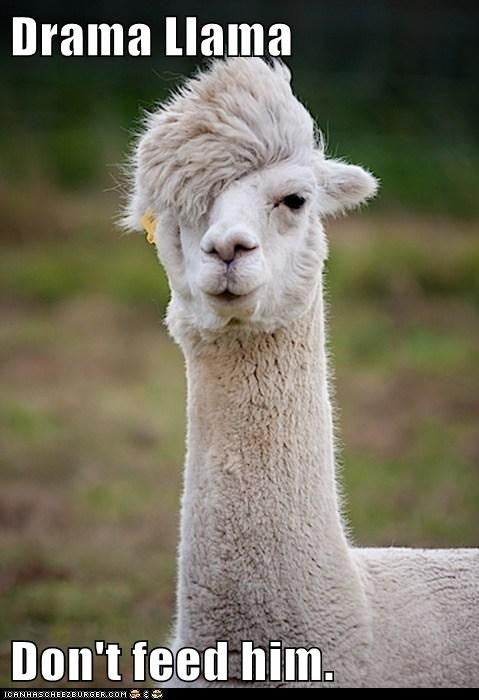
Pretty sound advice. 'Dat hair though!
In any RPG, you're going to run into different play styles, different approaches, different preferences in general. It's why we talk about things like MICE approaches, and GNS theory, and Robin Laws' player types. Because unlike film, the stage or the page (or monitor, I guess? E-reader screen?), RPGs are a collaborative storytelling medium by nature. Getting one person's cohesive vision through an RPG is really difficult, and frankly, undesirable. RPGs are special in large part because they're collaborative; it's that quality that leads to such investment from the creator/audience, and makes them so damn memorable and engaging.

But.

Ask anyone who's been in a band how easy it is to get creative types on the same page. For that matter, anyone who's ever tried to get human beings to agree on where to go for lunch. Coordinating different agendas is tricky, and takes buy-in from everyone to make work; it's not just the GM's responsibility.

Once more, with feeling:

It's not just the GM's responsibility

The GM has the most capability to make this work, it's true. By setting scenes, moving the spotlight around, and keeping everybody's approaches in mind, they have the best seat to make this work. But without buy-in, active cooperation, and a heavy dose of mindfulness from the players, there's only so much to be done. Yes, the GM can - and should! - note their players' preferences, and keep moving things around so that everybody gets their particular itches scratched.

So with our example group above; if we've spent an hour of game time exploring Alien Tea Ceremonies (Hideo's thrilled), and we even managed to provide a moment of character reflection for Paulina, it's probably a good time to shift focus on to investigating the ambassador's murder, letting Alex sink hir teeth into the mystery, and giving Jo the satisfaction that no, nobody's forgotten about the impending end of the world.

And if the players are cognizant of this, then not only are they more patient when the focus isn't on their approach, there's more permission for everybody to engage with whatever's going on, because they know that they won't be forgotten about.

That takes mindfulness, and trust. But if you can get everyone on the same page, a game starts to really sing in ways it otherwise can't. If keeping these concepts in mind helps out with that, then this column has done its job.

If not, well, llamas and mice. Still pretty good times!

~Killstring


1 - Why yes, I did link the Wikipedia article. It's succinct. I had originally linked Witte's original EPPM paper, simply for the joy of doing so in an RPG blog. (Which, consequently, I have now done anyway), but I'd rather people get a quick, clean idea of what I mean. I love communication models, and given the chance, will gab about them incessantly.

2 - Pretty sure my old thesis committee doesn't read this blog. That's probably for the best ¯\_(ツ)_/¯ 

3 - Also for the sake of sparing y'all more Mouse Jokes. You're quite welcome.


Friday, April 22, 2016

Of MICE and Men...

... and women, and gender-neutral pronouns, and folks who strongly self-identify as reincarnated Egyptian deities. Evetybody's welcome at The Blog of Doom, but the joke in the title demands alliteration.

With that understood, today I want to talk a bit about MICE.

okay but why are you shouting about mice

I AM A PIKA MOUSE AND I AM ACTUALLY QUITE CALM AT THE MOMENT! THIS IS JUST HOW I TALK!
So, MICE is an acronym - Milieu, Idea, Character and Event - and the balance between these four factors determines what can, must or should be in the story. Coined by Orson Scott Card in his excellent book on characters, I've found it to be an incredibly useful tool when trying to ascertain, what, exactly, a story is about. The idea is simple; every fiction story contains elements of each, but only one will wind up being the focus. And it's important to know the kind of story you're working on, and then do that.

Let's walk through it.

Milieu

Where does a story take place? In RPGs, we usually call this the setting, but the idea remains the same. The milieu includes not just the physical locations - one city, a sprawling wilderness, a series of curiously homogeneously-climated planets - with the associated sights, sounds and smells that come with the territory. It also includes the culture - social mores, laws and customs - the factors that shape how people think and react, and the choices they make.  


Lord of the Rings is a pretty good example of a Milieu story - the tale is really about Middle Earth, its people, their culture - and this informs what we do there. LotR starts way before the action, and only ends once Frodo and the Elves have departed Middle Earth forever - long after the climatic events have taken place.

The setting is the main character. We follow its journey, explore its depths, and we're not done until we've seen it all. 

Milieu stories are less common in fiction, but they actually show up a fair amount in video games and RPGs. A "discovery campaign" - where PCs plumb the secrets of a setting, learning cool new things at every turn - can be incredibly rewarding. "Sandbox"-style video games do this as well; Skyrim is a fine example of this, as while we've got two major plotlines in the civil war, and the rise of the dragons, those are things that are happening to the setting; the Dragonborn's just along for the ride.

Or not, if they don't feel like it.

And that gets to the heart of why milieu stories show up with more frequency in interactive media: if the player gets to decide what the story's about, then they'll go wherever they damn well please, and do as they wish. With less control over the other three factors, the milieu gets extra attention, and becomes the focus by default. 

Are you crafting a milieu story? If the setting is what really gets you exited, than probably. You still need strong characters, and something needs to happen to it all (unless you're writing a cultural "splatbook" for an RPG, in.  which case, you still need to provide idea seeds for GMs to make something happen in your beautiful setting), but if the focus is on the setting, then everything else can - and probably should - take a backseat to the milieu.

Idea

This is a classic structure; a problem or question is posed, and the story is concluded when we've answered the question, or solved the problem. Murder mysteries use this structure almost exclusively, as do heist/caper stories. Who killed this person? Once we know, we're done. How do we pull off this heist? The climactic scene is the heist itself, where we see how smoothly the protagonists' plan goes - usually not very - and then we call it a day.

Science fiction stories often use this structure too, but the title can be a bit deceiving. Technically, having some kind of "what if?" idea is a baseline requirement for something to be sci-fi in the first place, but that doesn't mean we're dealing with an idea story. 

If the idea is "what are the effects on society after a singularity?" that might be a milieu story.

If the idea is "How does Janice deal with the fact that her toaster's sentient and feels unloved?" that's probably a character piece. 

If the idea is "what happens when the singularity occurs?" it might be an event story.

But if the idea is "what happens to Dash Awesomelaser when all of his rad weapons gain sentience and become pacifists? How will he escape/triumph/not die horribly?"

A lot of RPG adventures follow this structure. Something has happened, and it's up to the PCs to get to the bottom of things/set it right/burn down the village because they're a bunch of amoral jerkwads/save the day. You get the picture.

Introduce problem. Story wraps when problem is solved. It goes without saying that an interesting idea is what's going to carry this kind of story.

Character

Not to be confused with "a story that has interesting characters," a character story is about someone trying to change their role in life. It starts when they find their current situation untenable, and they try to change; it ends when they've either succeeded in finding a new role, or given up, and returned to the old one.

It's worth talking about role a little bit here. Not to be confused with somebody's role in the story, a character's role in life is about their relationships with other people, and with society. If someone is happy, well-adjusted to their role in life, we don't really have a character story in the making. 
Affleck's done many fine things. But the character work in Jersey Girl is not among them, and the movie falls apart because of it.
A good example of a bad example.
So if you're wondering why so many stories are about unhappy people, this is why. Without enough dissatisfaction to leave their situation, we don't have a story; their tale begins when their role becomes unbearable. This doesn't always mean in a physical sense - you can have a character story about people who try to change a relationship without cutting the person out of their lives. In fiction - as in real life - this is incredibly difficult to manage, but it can lead to incredibly nuanced stories if done well.

Without conflict, we have no story. With conflict, we have story. Yay story!

It goes without saying that your characterization needs to be strong for this type of story to work.

Event

So, every story has events. Probably even a big, central conflict! But in an event story, the world is imbalanced somehow, and the story is about setting that right. It starts when the protagonists set out to heal the world from what ails it, and ends when they either succeed, or fail completely.

It's not hyperbole to suggest that the majority of stories are event-based. Evil forces what need stoppin' is a tale as old as history, and taps into some deep, primal stuff. The idea that the world should make sense, that there should be some kind of order, and that terrible things should be averted, or at least stopped? This is some fundamentally human stuff. 

So if you're wondering why we're always off to save the city/world/galaxy/space-time continuum from some Big Nasty, it's because the Big Event story is hardwired into our DNA. We've been telling these stories since we've been telling stories, and that's likely to continue.

So, if you're telling an event story, you need a compelling and credible threat, and addressing it should provide a palpable sense of relief. You also need to convey that the problem is actually a problem, and the world is genuinely better off without it. 

This is not to say that there haven't been very successful event stories that posit key societal values as The Problem - any tale about the evils of capitalism being told to a capitalist society qualifies - but if you want your story to work, the character's viewpoint needs to seem reasonable. Otherwise, they're the problem, because they're the ones looking to destroy society. 

They're the villain.

And you can have incredible stories about villains! Just recognize what you're doing, and do it on purpose. Which segues nicely into our conclusion:

A conclusion

Anytime you're telling a story, you're making an implicit contract with the audience. Whether your writing a song, GMing an RPG, whatever - you're implicitly telling your audience the kind of story you're going to tell them. And if they like what you're doing, they'll stick around to the conclusion of your story. Which is why it's so important to know what kind of story you're telling.

So if you begin with a murder, and focus on some characters who are interested in solving said murder, people can reasonably expect that, y'know, you will address that at some point. You've told them that the murder is important - you've told them that you're telling an idea story - and they'll hold you accountable to that.

If, on the other hand, the murder sets off a series of political maneuvering - and you focus on that in great detail - then you're communicating that this might be a milieu piece. Or maybe you focus on the murder victim's teenage child, struggling to cope with this massive change in their life, and how this has massively disrupted their life; in which case, people will expect you to resolve this character drama.

This doesn't mean you can't do both - but inexorably, one of these is going to be a subplot. We'll gladly follow the political fallout, and the child's search for identity - but you told us that this story was about solving a murder, so, y'know, you'll want to address that. Because you told your audience what this story was about. If you never resolve that, they'll feel betrayed - and not even in a fun, "George R.R. Martin, how could you?" kind of way - they'll feel like you lied to them. 

Don't do that.

Since I opened with a bit from Card's book, it seems like a good idea to wrap up with another:
"(Your audience) will expect the story to end when the first major source of structural tension is resolved."
Beginning a story is like throwing something out a window. No matter what happens before the end of the story, we're not done until that's resolved. Maybe it hits the ground. Maybe someone catches it. Maybe it develops self-awareness, and flies off into the sunset. 

But the story's not over until we know.